

Wireless Technology and Male Fertility: The Hidden Impact of Laptops, Cell Phones, and WiFi
Updated June 3, 2026
If you are looking to start a family or plan to have children in the future, you might want to rethink resting your laptop directly on your lap.
We are currently witnessing a sharp decline in male fertility worldwide. In some developed regions, such as the United States and the United Arab Emirates, fertility rates have dropped by 30% or more since 1980. Furthermore, global sperm counts have plummeted by an estimated 50% since 1973. Researchers continue to debate the primary causes—ranging from environmental toxicity to the rise of hormone-disrupting chemicals like BPA and the pervasive use of pesticides.
However, alongside these environmental factors, a growing body of evidence suggests we should be looking closely at our daily technology.
The Misnomer of the "Laptop"
While the name "laptop" implies the device is intended for use on one’s lap, emerging research suggests we should be maintaining a physical distance from these devices. This is due to Electromagnetic Fields (EMFs) - a low-energy form of radiation emitted by all electronic devices.
Extended exposure to EMFs can interfere with cellular processes, potentially leading to adverse health effects. Resources such as EMFresearch.com have compiled over 300 studies linking EMF radiation to fertility issues. Recent data suggests that EMFs impact not only male sperm production and quality but may also affect the health of a developing fetus.
Why are Men More Vulnerable?
Male infertility currently affects approximately 1 in 20 men. In many cases, the male produces a sufficient quantity of sperm, but "conception failure" occurs due to DNA defects or poor motility.
Biologically, men are significantly more vulnerable to EMF radiation than women. While female reproductive organs are protected deep within thick tissue and pelvic bone, male reproductive organs are located near the surface of the body, lacking that dense biological shielding. Consequently, the past decade of medical research has focused heavily on how environmental factors—specifically the radiation from laptops and cell phones—contribute to sperm damage.
The Link Between Cell Phones and Semen Quality
Early investigations into DNA damage in human sperm highlighted Radio Frequency (RF) radiation emitted by mobile phones as a key culprit.
Years of collaborative research indicate a negative correlation between frequent mobile phone usage and semen quality. A 2008 U.S. study found that cell phone use reduced sperm count, motility (swimming ability), viability, and morphology (shape). Furthermore, a 2009 study confirmed that cell phone radiation induces oxidative stress in human semen. Because many men carry their phones in their pockets, this radiation is positioned in direct proximity to the genitalia, posing a constant risk to reproductive health.
Animal studies have mirrored these findings. A 2013 study on rats found that cell phone waves caused significant oxidative stress, leading researchers to recommend that individuals who use mobile devices heavily should monitor their reproductive health and maintain a diet rich in antioxidants to mitigate the damage.
Laptops and Wireless Networks (WiFi)
Recent studies have expanded to include the radiation emitted by WiFi-connected laptops. Research shows that using a laptop on the lap—especially when connected to a wireless network—is associated with decreased sperm motility and increased DNA fragmentation.
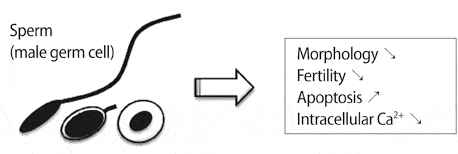
For successful conception, sperm must have the "motility" to reach the egg and "intact DNA" to produce a viable embryo. A study published in 2012 in the medical journal Fertility and Sterility illustrated this risk:
- Researchers placed sperm samples from healthy men under a laptop connected to WiFi for four hours.
- A control group was incubated under the same temperature conditions but without laptop exposure.
- The results: 25% of the exposed sperm became inactive (compared to 14% in the control group), and 9% showed DNA damage - three times the damage found in the unexposed samples.
The scientists concluded that RF radiation from WiFi is a primary driver of these significant decreases in sperm health.
The Deeper Problem: RF Radiation May Be Undermining Fertility at Its Source
Most research on wireless technology has focused on direct damage to sperm. But a 2026 study published in Scientific Reports reveals that the problem may go deeper than sperm quality alone.
Researchers exposed Leydig cells, the testicular cells responsible for producing testosterone, to radiation from a 4G mobile phone, 1800 MHz, and 2450 MHz (the same frequency used by WiFi) for durations ranging from 150 to 120 minutes. All exposures were conducted under strictly controlled non-thermal conditions, meaning no tissue heating occurred. The results showed that RF exposure progressively suppressed DNA synthesis in Leydig cells and disrupted their cell cycle, causing cells to stall before they could replicate. Physical damage was also visible: cells lost their shape, detached from surfaces, and showed signs of membrane breakdown. The effects were worst at longer exposure durations and at the 2450 MHz WiFi frequency.
This matters because if Leydig cells can’t proliferate normally, testosterone production declines. And without adequate testosterone, spermatogenesis is compromised at its source. The study adds a critical layer to our understanding: RF radiation doesn’t just damage sperm after they’ve been produced.
Critically, all of this occurred at exposure levels that did not cause any tissue heating, reinforcing the growing body of evidence that current safety standards, which are based solely on thermal effects, fail to account for the biological harm that RF radiation can cause at non-thermal levels.
The Scientific Debate
While the evidence is mounting, the scientific community is not in total agreement. Some experts remain skeptical of the "real-world" application of these lab studies.
Dr. Robert Oates, president of the Society for Male Reproduction and Urology, argues that these studies often use artificial settings that may not reflect human biology. “It is scientifically interesting," Dr. Oates notes, "but to me, it doesn’t have any human biological relevance.”
However, other specialists point to the cumulative effect. A review in a South Korean medical journal of over 70 publications indicated that reproductive traits were consistently altered by EMF exposure. For example, rats exposed to 900 MHz (a frequency similar to daily human tech use) for just 30 minutes a day showed measurable testicular tissue damage.
How to Protect Your Fertility
Despite the ongoing controversy, many experts view laptop and WiFi exposure as a growing public health concern. As we transition into the era of 5G technology, which will significantly increase the density of signals in our environment, limiting exposure becomes even more vital.
To protect your reproductive health, consider these practical steps:
- Create Distance: This is the most effective defense. Avoid using a laptop directly on your lap. Keep routers in a separate room, and avoid carrying your cell phone in your pocket whenever possible.
- Use Shielding: If you must use a laptop on your lap, utilize an EMF-blocking shield or tray designed to redirect radiation away from the body.
- Hardwire Your Connections: Whenever possible, turn off the WiFi and use an Ethernet cable to connect your devices to the internet.
- Practice "Smart Usage": Switch devices to airplane mode when not in use. Use the speakerphone or "airtube" headsets for calls rather than holding the phone directly against your head.
- Dietary Support: A diet high in antioxidants (found in colorful fruits and vegetables) can help your body combat the oxidative stress caused by inevitable EMF exposure.
As technology becomes more pervasive, taking proactive, common-sense precautions is the best way to ensure your long-term reproductive health.
Watch Below for More About the Health Effects: